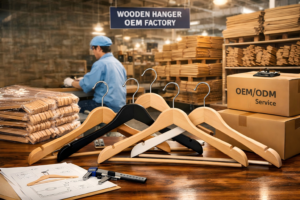
Every detail in a retail store contributes to the overall shopping experience. From the lighting to the background music, visual merchandising dictates how customers perceive a brand’s value. Among these merchandising tools, the choice of garment hangers is one of the most critical decisions a retail buyer or operations manager can make.
For retailers displaying pants, skirts, and trousers, the decision often comes down to a classic debate: wooden pant hangers versus plastic pant hangers. While both options serve the basic purpose of holding apparel, they offer vastly different advantages in terms of cost, presentation, durability, and brand alignment. This guide breaks down the key differences to help you choose the best option for your business.
Why Hanger Choice Matters in Retail
Before analyzing the materials, it is essential to understand why this decision carries so much weight in a retail environment.
Visual Merchandising
A hanger is the frame for your garment. If a hanger is flimsy or sags, the garment will look poorly tailored and unappealing. Uniform, high-quality hangers create clean, symmetrical lines across your clothing racks, drawing the customer’s eye to the apparel rather than distracting them with messy displays.
Product Protection
Pants are particularly prone to slipping, creasing, and stretching. The right hanger keeps trousers secured in place without leaving damaging indentation marks, snagging delicate fabrics, or allowing garments to fall onto the dusty retail floor.
Customer Perception
Hangers are a physical touchpoint. When a customer reaches for a pair of pants, the weight and texture of the hanger send an immediate, subconscious signal about the garment’s quality. A heavy, solid hanger elevates the perceived value of the apparel, making customers more comfortable with premium price points.
Advantages of Wooden Pant Hangers
Wooden hangers have long been the industry gold standard for premium presentation, offering a range of distinct benefits.
Premium Appearance
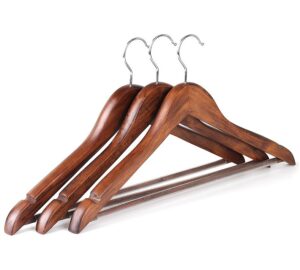
Nothing matches the natural warmth, rich grain, and luxury feel of authentic wood. Whether finished in a natural clear coat, a sleek matte black, or a deep walnut stain, wooden hangers instantly elevate the store aesthetic, making it feel like a curated boutique rather than a mass-market warehouse.
Superior Durability
Crafted from dense hardwoods like beech, lotus, or maple, wooden hangers are built to last. They do not bend under the weight of heavy wool trousers, denim, or leather pants, and they can withstand years of constant handling by staff and customers without snapping or cracking.
Stronger Support for Heavy Garments
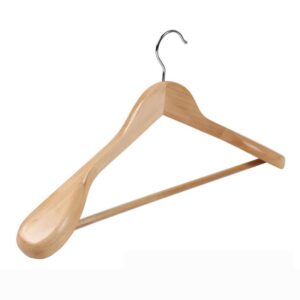
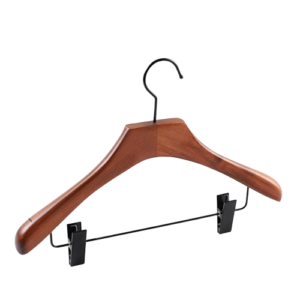
Wooden pant hangers are engineered for heavy-duty support. Whether featuring a thick, felt-wrapped wooden bar or heavy-duty metal clips, they distribute weight evenly, ensuring that structured garments maintain their shape and drape perfectly on the rack.
Advantages of Plastic Pant Hangers
While wood represents luxury, plastic hangers dominate high-volume retail sectors for practical, operational reasons.
Lower Cost
The most compelling advantage of plastic hangers is their affordability. Mass-produced through injection molding, plastic hangers have a incredibly low per-unit cost, making them highly attractive for startups, budget-conscious retailers, and nationwide chains.
Lightweight
Plastic hangers are exceptionally lightweight. This minimizes the physical strain on retail staff during inventory resets and significantly reduces shipping and handling weights when moving stock from distribution centers to retail floors.
Suitable for Mass Retail
For high-volume operations, plastic hangers are highly efficient. They are easy to clean, quick to replace if damaged, and require less storage space when empty due to their ultra-slim profiles.
Cost Comparison: Upfront vs. Lifetime
When evaluating your budget, it is vital to look beyond the initial price tag and consider the total cost of ownership.
+-----------------------------------------------------------------+
|                       COST COMPARISON                           |
+-----------------------------------------------------------------+
|  WOODEN HANGERS                                                 |
|  - Initial Cost: Higher                                         |
|  - Lifespan: 5 to 10+ Years                                     |
|  - Long-Term Value: High (Rarely need replacement)              |
|                                                                 |
|  PLASTIC HANGERS                                                |
|  - Initial Cost: Low                                            |
|  - Lifespan: 6 to 18 Months (Frequent breakage)                 |
|  - Long-Term Value: Low (Constant re-ordering required)         |
+-----------------------------------------------------------------+
While plastic hangers require a much smaller upfront investment, they are prone to breaking at the hooks, clips, or joints under daily retail wear. This leads to a constant, recurring replacement cost. Wooden hangers, though more expensive initially, can easily last a decade, ultimately offering a lower cost-per-use over their lifetime.
Sustainability Comparison
In 2026, sustainability is a major driving force behind retail purchasing decisions, heavily influenced by global regulations and consumer expectations.
Recyclability & Material Lifespan
- Wooden Hangers: Wood is a natural, biodegradable, and renewable resource. When paired with recyclable metal hardware, wooden hangers can be easily disassembled and recycled at the end of their lifespan, or left to biodegrade safely.
- Plastic Hangers: Most cheap plastic hangers are made from mixed-grade polymers or polystyrene, which are incredibly difficult to recycle. Millions of plastic hangers end up in landfills every year, taking centuries to decompose.
Eco-Friendly Brand Image
Using sustainable wood hangers—especially those with FSC (Forest Stewardship Council) certification—allows brands to showcase their commitment to environmental responsibility. This aligns your visual merchandising directly with the values of modern, eco-conscious shoppers.
Environmental Regulations
Particularly in Europe, strict Extended Producer Responsibility (EPR) laws and single-use plastic taxes are punishing retailers who utilize non-recyclable plastic fixtures. Transitioning to sustainable wood or bamboo hangers helps retailers bypass these financial penalties and future-proof their operations.
Best Use Cases for Wooden Hangers
Wooden hangers are the ideal choice for businesses where brand image, garment care, and premium presentation are paramount.
- Luxury Boutiques: Essential for maintaining a high-end, exclusive atmosphere where every detail must reflect luxury.
- Premium Fashion Brands: Perfect for denim, tailored suits, evening wear, and structured trousers that require strong support and a flawless presentation.
- Upscale Hotels: High-end hospitality closets demand the elegance and heavy-duty durability of wood to satisfy discerning guests.
Best Use Cases for Plastic Hangers
Plastic hangers remain a highly practical and necessary choice for specific retail business models.
- Fast Fashion Chains: Ideal for rapidly rotating inventory, high-volume sales floors, and budget-friendly apparel displays.
- Discount Retailers & Supermarkets: Perfect for mass-merchandising environments where low operational costs and high density are the primary objectives.
- High-Volume Logistics: Highly efficient for shipping garments directly from factories on hangers (GOH – Garment On Hanger systems) where hangers are designed to be disposable or single-use.
Which Option Is Better for Your Business?
To choose the right hanger strategy, align your choice with your core business metrics:
1. Based on Brand Positioning
If your brand positions itself as premium, ethical, organic, or artisanal, wooden hangers are non-negotiable. Using plastic hangers in an organic clothing boutique will immediately damage your brand credibility. If your brand is focused on affordability, speed, and modern trends, plastic hangers fit your operational model perfectly.
2. Based on Budget
Evaluate your cash flow. If you have the capital for a larger upfront investment, investing in wooden hangers will save you money over time by eliminating replacement costs. If you are launching a startup with tight initial capital, high-quality, uniform plastic hangers can help keep your opening costs low.
3. Based on Target Customers
Understand what your customers value. If your target demographic is Gen Z or Millennial shoppers who heavily prioritize sustainability and circular fashion, investing in FSC-certified wooden or bamboo hangers is a powerful way to win their loyalty.
Conclusion
There is no single “right” choice—only the right choice for your specific business model. Wooden pant hangers offer unmatched luxury, durability, and eco-friendly credentials, making them an excellent long-term investment for premium fashion brands and boutiques. On the other hand, plastic pant hangers provide the lightweight, cost-effective, and highly efficient solution required by mass-market, fast-fashion retailers.
Analyze your brand positioning, your target audience, and your long-term operational budget to choose the hanger strategy that best elevates your merchandise and supports your bottom line.